“They’re Just Being Defiant”: Why Math Refusal May Be a Sign Your Child Is Struggling

Your child is sitting at the kitchen table with a math worksheet in front of them.
You know they have completed problems like these before. Their teacher says they understand the lesson. You have read the directions, offered help, and reminded them several times that the assignment needs to be finished.
Still, they will not begin.
Maybe they put their head down. Maybe they argue about every direction, make jokes, ask for a snack, or suddenly need to find a different pencil. Maybe they say, “This is stupid,” close the computer, or insist they do not know how to do anything.
After a long day, it can look like defiance.
You may find yourself thinking, “You know how to do this. Why won’t you just sit down and finish it?”
Meanwhile, your child may be experiencing something very different:
“I don’t know how to get started. There are too many problems. I’m afraid I’ll get them wrong, and I don’t know how to explain what is happening.”
Sometimes children do choose not to follow a direction.
But the behavior we see from the outside does not tell us why it is happening.
Math refusal may be defiance, but it may also be a sign of:
anxiety
overwhelm
missing skills
executive-function difficulties
depleted capacity
a child trying to protect a fragile sense of competence.
Before deciding that a child will not do the math, we need to look beneath the behavior and ask what is making it difficult for them to begin, persist, or show what they know.
This is the third article in a four-part series about math avoidance. If you are beginning with the question behind the behavior, read Why Does My Child Refuse to Do Math? Understanding Math Avoidance in Children With ADHD. To explore specific causes, continue with What Triggers Math Avoidance in Children With ADHD?.
Is My Child Being Defiant or Overwhelmed?
There is no single behavior that proves a child is defiant, anxious, overwhelmed, or unable to do the work.
Two children can both say, “I’m not doing this,” for completely different reasons.
Even the same child may refuse math for one reason on Monday and another reason on Thursday.
That is why it helps to separate what we observe from what we assume.
“My child is defiant” is an interpretation. “When I gave my child 20 fraction problems, they stared at the page, argued about the directions, and did not begin” is an observation.
The observation gives us something useful to investigate.
Was the page too long?
Were the directions unclear?
Did the child know how to find a common denominator?
Had they just come home from a demanding school day?
Were they worried that one mistake would lead to correction, disappointment, or another long homework battle?
Looking for the cause is not the same as excusing hurtful or unsafe behavior.
Children still need boundaries, and they need to learn respectful ways to ask for help, clarification, or a break.
Understanding the cause simply helps us teach the right skill instead of repeatedly punishing the signal.
Why Math Refusal Can Look Like Defiance
Math creates a particular combination of pressure for many children.
It is cumulative, so unfinished learning from earlier grades can reappear in every new lesson.
Answers are usually seen as clearly right or wrong.
Students may be asked to work quickly, show every step, remember several rules, and compare their progress with classmates.
When a child expects math to feel confusing, embarrassing, or exhausting, avoidance offers immediate relief.
Arguing delays the worksheet.
A bathroom trip creates a break.
Joking saves face.
Rushing ends the task faster.
Saying “I don’t care” may feel safer than trying hard and still getting the answer wrong.
These behaviors can be frustrating for adults, but they often serve a purpose for the child: escaping or postponing an experience that feels unmanageable.
The Vanderbilt University IRIS Center explains that escape-related behavior can begin with an academic skill deficit.
In simple terms, a child may avoid work because they do not yet have the skills to complete it independently.
Missing math skills can hide beneath refusal
Math builds on itself.
A worksheet labeled “adding fractions” may also require a child to recall multiplication facts, understand equivalent fractions, find common denominators, organize written work, and hold several steps in mind.
If one of those foundations is weak, the assignment can feel much harder than it appears.
The adult sees a familiar worksheet. The child experiences a chain of steps they cannot reliably complete.
This is one reason more practice is not always the answer.
If a child is missing an underlying concept, asking them to complete 20 additional problems may increase frustration without repairing the gap.
They may need explicit teaching, a visual model, guided practice, or a return to the prerequisite skill.
ADHD can affect starting, remembering, and persisting
For some children with ADHD, understanding the math is only one part of the task.

They must also shift away from another activity, gather materials, interpret the directions, decide where to begin, remember multiple steps, ignore distractions, monitor their work, and manage frustration.
Task initiation is a skill of its own.
A child can know how to solve a problem and still be unable to organize themselves well enough to start it.
Working-memory demands can also cause a child to lose their place, forget a direction, skip a step, or restart repeatedly.
Not every child with ADHD has the same executive-function profile. Still, research has found connections between executive-function difficulties and homework problems in students with ADHD.
This helps explain why a child may complete work with a teacher or tutor nearby but struggle when expected to manage every part of the task alone.
Math anxiety uses resources needed for math
Math anxiety is more than disliking a subject. An anxious child may be trying to solve the problem while also thinking:
“I’m going to get this wrong.”
“Everyone else understands this.”
“This is going to take forever.”
“They are going to be disappointed in me.”
Those worries compete for attention and working memory, which can make multi-step math even harder.
Poor performance then seems to confirm the child’s fear.
The next time math appears, avoidance becomes more likely because avoiding the task briefly reduces the anxiety.
This can create a painful cycle:
Math feels threatening → the child avoids it → avoidance brings short-term relief → practice and learning decrease → math feels even harder next time.

Some children are protecting their confidence
Adults often experience a wrong answer as useful information.
A child with a history of math struggles may experience it as proof that they are not smart.
If trying feels emotionally risky, refusal can protect the child’s identity.
It may feel safer to say the assignment is pointless, rush carelessly, reject help, or pretend not to care. If they do not truly try, they do not have to discover whether they might fail.
The phrase “This is stupid” may sometimes mean, “This makes me feel stupid.”
That does not make disrespectful language acceptable, but it changes the most useful adult response.
A lecture about attitude will not repair a missing math skill or a damaged belief about learning.
After-school shutdown may reflect depleted capacity
Parents are sometimes confused when a teacher reports that their child worked at school, yet the child falls apart over a short assignment at home.
School requires children to manage noise, movement, transitions, social expectations, directions, self-control, and academic demands for hours.
Neurodivergent students may spend additional energy masking distress or suppressing movement and sensory needs.
By the time they arrive home, the capacity they used to hold everything together may be gone.
The child who completed math at 10:00 a.m. may genuinely have less access to the same skills at 4:30 p.m.
Hunger, fatigue, medication timing, sensory overload, and accumulated frustration all matter.
What Math Avoidance May Look Like
Shutdown is not always dramatic.
A child may stare at the page, become unusually quiet, erase repeatedly, or say “I don’t know” without reading the problem.
Avoidance may also look like losing assignments, changing the subject, sharpening a pencil, joking, rushing, arguing about minor details, asking for constant reassurance, or refusing help.
The behavior does not identify the cause, but patterns can offer clues.
What a parent sees | What may be underneath |
“I don’t know” before reading | Fear of being wrong, unclear directions, or difficulty starting |
Silence or head down | Overload, anxiety, exhaustion, or a freeze response |
Joking or silliness | Escaping difficulty, saving face, or seeking connection |
Arguing about directions | Confusion, uncertainty, or a need for control |
Rushing and careless mistakes | Low stamina, impulsivity, or a desire to escape |
Tears after one correction | Accumulated stress, perfectionism, or fragile confidence |
“This is stupid” | “This makes me feel incapable” |
Works with support but not alone | An initiation, organization, regulation, or confidence gap |
These are possibilities, not diagnoses. The goal is to become curious enough to test what helps.
What Parents Can Do Instead of Increasing Pressure
When homework has turned into a battle, it is natural to repeat the direction more firmly.
But if the child is already overloaded, more pressure can increase the very response we are trying to stop.
Regulate first
If your child is crying, yelling, frozen, or unable to respond, they may not be ready for another explanation.
Lower your voice, reduce the number of words you use, and pause the argument.
A drink, snack, brief movement break, or few quiet minutes may help the nervous system settle.
This is not a reward for refusing.
It is preparation for problem-solving. Regulation is what makes instruction accessible again.
Describe what you see without assigning a motive
Try saying, “I notice you have been looking at the page for five minutes and have not started,” instead of, “You are choosing to be difficult.”
Then ask a specific question:
“Do you understand what the directions are asking?”
“Is the hard part starting, remembering the steps, or doing the math?”
“Would it help to see one problem at a time?”
“Show me the first place where this stops making sense.”
Specific questions are easier to answer than, “Why are you doing this?” A child in distress may not know why.
Make the first step smaller
Instead of focusing on the whole assignment, identify the smallest useful action. That might be writing a name on the paper, circling the operation, reading the first problem aloud, or gathering the needed materials.
Some children benefit when an adult covers most of the page, begins the first problem with them, writes the steps on a card, or lets them explain the answer verbally before writing it.
The goal is not to do the math for the child. It is to reduce the barrier enough for the child to engage.
Match the support to the barrier
If directions are unclear, rephrase them.
If working memory is overloaded, keep an example and written steps visible.
If the assignment is too large, show only a few problems at a time and ask the teacher whether repetitive practice can be reduced after mastery is demonstrated.
If a foundational skill is missing, pause the current work and teach that skill directly.
The What Works Clearinghouse practice guide for students struggling with mathematics recommends explicit and systematic instruction, visual representations, guided practice, corrective feedback, cumulative review, and strategies that support motivation.
Use scaffolding without taking over
Support and independence are not opposites. Appropriate support creates a bridge to independence:
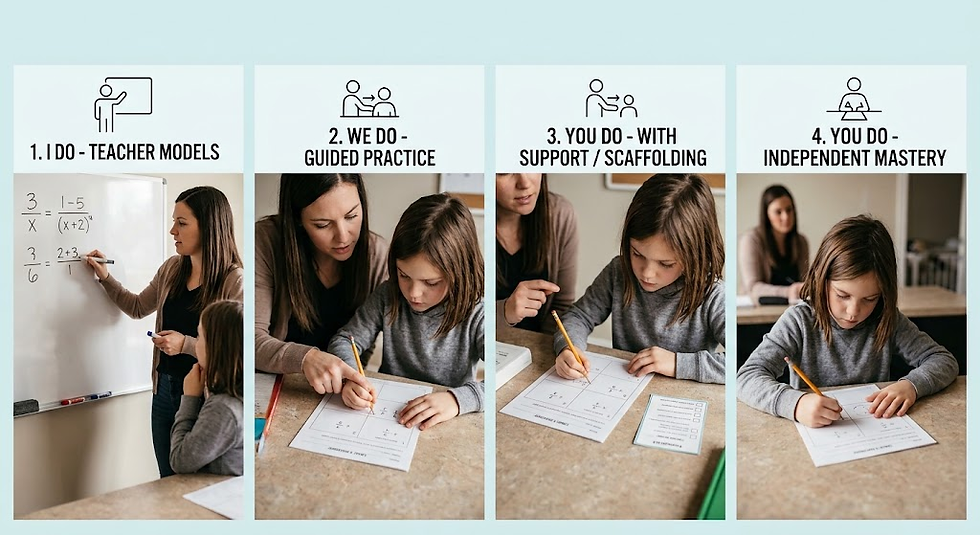
I do → We do → You do with support → You do independently
At first, you may model how to identify the operation.
Next, you and your child may choose it together.
Then your child may try while using a checklist.
Finally, the checklist or adult prompt can fade as the skill becomes more secure.
The important question is not, “Did I help?”
It is, “Which part did my child need help with, and how can I gradually return that part to them?”
Understanding Is Not the Same as Removing Expectations
A child can need to complete schoolwork and genuinely be unable to meet the current demand without support.
They can be responsible for learning a safer way to express frustration and need help developing that skill.
Parents can hold a boundary around yelling, throwing objects, or hurtful language while still responding compassionately to the distress underneath it.
You might say:
“It is okay to be frustrated. It is not okay to throw your pencil. Let’s take three minutes to calm down, and then we will decide whether you need the directions explained, the first problem started together, or a message sent to your teacher.”
This response keeps the boundary, preserves the relationship, and teaches the child what to do next time.
When to Ask for More Help
Occasional homework resistance is common.
Additional support may be helpful when math refusal happens regularly, conflict is affecting family relationships, your child’s distress is intense, avoidance is spreading to school attendance or other subjects, or your child repeatedly says they are stupid, incapable, or hopeless.
Begin by talking with the teacher.
Ask when the behavior occurs, which types of problems trigger it, and under what conditions your child succeeds.
A school team can investigate skill gaps and consider supports through general education, an intervention plan, a 504 Plan, or an IEP when appropriate.
A pediatrician or qualified mental-health professional can help when anxiety, depression, or severe emotional distress may be involved.
An occupational therapist may be useful when sensory or motor demands are significant.
A behavior analyst or school team may conduct a functional assessment when persistent behavior requires a more formal investigation.
As a tutor and math interventionist, my role is educational.
I look for unfinished math learning, observe where a student becomes stuck, and provide structured instruction, visual models, guided practice, executive-function supports, and appropriately paced challenges.
I do not diagnose behavior or replace clinical care.
A Different Question Can Change the Homework Conversation
When a child refuses math, the first question is often, “How do I make them comply?”
A more useful question is:
“What is making it hard for my child to begin, continue, or show what they know?”
That question does not remove responsibility.
It gives us a better chance of identifying the responsibility the child is actually ready to learn: asking for clarification, using a break appropriately, following a short checklist, tolerating a mistake, practicing a missing skill, or completing a manageable amount of work.
Behavior is communication, but it is not always clear communication.
When we look beneath math refusal with curiosity, boundaries, and compassion, we can move from repeated power struggles toward skill-building and confidence.
If your child is in grades 4–8 and math regularly ends in shutdown, avoidance, or conflict, learn more about my personalized online math tutoring and intervention services.
I work with students with ADHD, autism, math anxiety, and other learning differences to identify the barriers beneath the struggle and rebuild skills one step at a time.
You are also welcome to contact me for a free, no-pressure conversation about what you are seeing at home.
Next in this series: What Math Avoidance Looked Like for One Student and How Safe, Supportive Tutoring Helped.
Frequently Asked Questions About Math Refusal
Why does my ADHD child refuse to do math?
An ADHD child may refuse math because of difficulty starting, working-memory overload, unclear directions, a long or repetitive assignment, weak foundational skills, anxiety, fatigue, or fear of failure. Refusal describes what you see, not the reason. Look for patterns in when the behavior happens and what type of support helps the child engage.
How can I tell the difference between ADHD defiance and overwhelm?
You usually cannot tell from the behavior alone. Observe what happened immediately before the refusal, the child’s emotional and physical state, the difficulty and length of the task, and the conditions under which they can succeed. If reducing one barrier helps them begin, that provides useful information about what may have been underneath the behavior.
Should I let my child stop when math causes a shutdown?
When a child is highly dysregulated, pause the argument and help them regulate before returning to instruction. A pause does not have to mean abandoning the learning goal. Once calm, decide whether to shorten the task, clarify directions, begin together, practice a prerequisite skill, or contact the teacher about an assignment that is not accessible.
Is math refusal a sign of math anxiety?
It can be. Children with math anxiety may freeze, avoid beginning, rush, seek reassurance, become upset by corrections, or complain of physical discomfort. The same behaviors can have other causes, so patterns should be investigated rather than diagnosed from one incident.
Can a math tutor help a child who refuses schoolwork?
A specialized tutor can help when refusal is connected to missing math foundations, low confidence, task-initiation barriers, working-memory demands, or a mismatch between instruction and the child’s learning needs. Tutoring is not a substitute for mental-health or behavioral care, but it can reduce academic barriers and create supported opportunities for success.
About the Author
Alia Zundel is the founder of A to Z Learning LLC and a licensed elementary and special education teacher with a B.A. in Special Education and Elementary Education.
As a math interventionist and online tutor, she supports students in grades 4–8, including children with ADHD, autism, math anxiety, and other learning differences.
Alia is also the parent of three neurodivergent children. Her approach combines evidence-informed math instruction with practical experience supporting students through frustration, shutdown, avoidance, and rebuilding confidence.
She provides educational support and collaborates with families while encouraging them to consult appropriate school and clinical professionals when a child’s needs extend beyond tutoring. Learn more about Alia and A to Z Learning.
References and Further Reading
Fuchs, L. S., et al. Assisting Students Struggling with Mathematics: Intervention in the Elementary Grades. What Works Clearinghouse, Institute of Education Sciences.
Vanderbilt University IRIS Center. Behavioral Form and Function.
Vanderbilt University IRIS Center. Functional Behavioral Assessment: Identifying the Reasons for Problem Behavior and Developing a Behavior Plan.
Ramirez, G., Shaw, S. T., and Maloney, E. A. Math Anxiety: Past Research, Promising Interventions, and a New Interpretation Framework. Educational Psychologist.
Trezise, K., et al. Mathematics Anxiety and Working Memory.
Langberg, J. M., et al. Patterns and Predictors of Adolescent Academic Achievement and Performance in a Sample of Children With ADHD.
National Council of Teachers of Mathematics. Procedural Fluency in Mathematics.



Comments