How to Help Your Child Practice Math Over the Summer

Summer break is finally here. That means sunshine, vacations, sleeping in, pool days, and long afternoons filled with play. It also means a break from school routines and academic practice.
You have probably heard the phrase, “Use it or lose it.” When we practice a skill consistently, that skill becomes stronger and easier over time. But when we stop using it for long periods, it becomes harder to remember. This is especially true with math.
Many children experience what educators call the “summer slide,” where academic skills weaken during the long break from school. In math, this can look like slower computation, difficulty remembering basic facts, forgetting procedures, or struggling to connect concepts they previously understood.
Of course, children value their free time, and most do not want summer to feel like school. Most adults feel the same way about work during vacation time. The good news is that practicing math during the summer does not need to feel overwhelming, stressful, or time-consuming.
In fact, just a few minutes a day can make a huge difference.
So how can parents help children continue practicing math while still enjoying the fun and freedom of summer? Here are several simple and realistic ways to keep math skills active during the break.
Workbooks
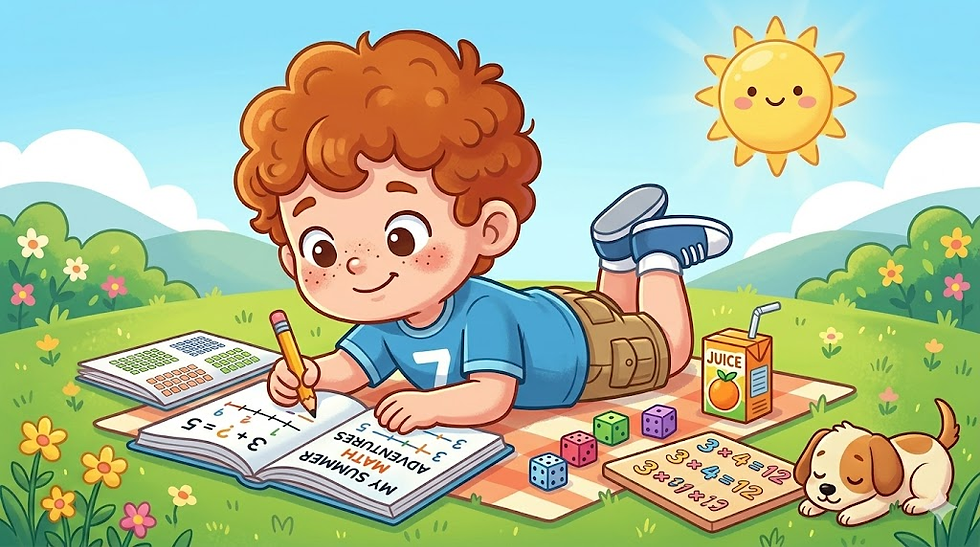
Workbooks are one of the easiest ways to keep math practice available throughout the summer.
When my children were younger, we celebrated the end of the school year with a trip to the bookstore. Each child picked out a workbook of their own, usually one that included several subjects. Having their “special” workbook made it feel more exciting and personal.
We built a few pages into our daily routine. Sometimes they completed them before heading outside to play, but more often we used the hottest part of the afternoon as quiet workbook time. When my children were in the younger elementary years, they loved it. As they got older, the excitement faded a bit, but the consistency still helped maintain their skills.
Pros
Easy to find
Ready-to-use practice with little preparation for parents
Only requires a few minutes each day
Helpful for reviewing previously learned skills
Cons
Can cost money
Easy to forget or set aside
May feel too much like schoolwork for some children
Games

Games are one of the best ways to make math feel natural and enjoyable. Many games already include counting, number recognition, strategy, or computation without children even realizing they are practicing math.
For younger children, games that use dice or spinners naturally encourage counting and number sense. Children count spaces, identify quantities on dice, and practice one-to-one correspondence while they play. Classic games like Candy Land or Chutes and Ladders are wonderful for practicing counting skills.
For older children, games can involve more advanced math concepts. Monopoly includes counting money, budgeting, making change, and strategic thinking. Fantasy and adventure games like Dungeons & Dragons combine storytelling with math through dice rolls, addition, subtraction, and tracking character statistics.
Games do not always need to come from a store, either. Sometimes the simplest activities become the most effective.
A friend of mine “tricks” her children into practicing math by turning it into a competition. She uses a dice app on her phone, and the children race to add or multiply the numbers rolled.Whoever answers first earns the point. The kids think they are just playing, but they are building math fluency at the same time.
Creating your own games does take a little creativity, but it can also make math practice flexible and portable for road trips, waiting rooms, or restaurants.
Pros
Fun and engaging
Connects math with playtime
Encourages critical thinking and problem-solving
Helps children build positive feelings about math
Cons
Some games can be expensive
Parents may need to plan ahead or get creative
Certain games take longer to play
Everyday Life Experiences
One of the best ways to practice math is by simply noticing how often we already use it in everyday life.
Math is everywhere. Children can practice valuable skills during errands, cooking, shopping, traveling, or even while driving around town.
At the grocery store, children can:

Add prices together for a running total
Compare prices between brands
Calculate unit prices
Estimate costs before checkout
Practice budgeting skills
While driving, younger children can:
Read house numbers and street signs
Count objects they see
Practice skip counting or multiplication facts
The kitchen is another excellent place for math practice.Cooking naturally includes:
Counting
Measuring
Fractions
Multiplication
Time management
Children often learn best when math feels useful and connected to real life.
When my children were growing up, we used beans as a reward system for chores and positive behavior. Each bean could be traded for either 30 minutes of screen time or 25 cents.
Because of this system, my children practiced counting constantly. They learned how many quarters make a dollar, how to budget for things they wanted, and how time and money connect to choices.
I am not suggesting every family should use this exact system, but it worked well for us because the math had meaning. The skills became part of daily life instead of separate “school work.”
Pros
Shows children how math applies to real life
Builds practical problem-solving skills
Encourages meaningful conversations
Helps math feel useful instead of abstract
Cons
Can make errands or tasks take a little longer
Requires parents to intentionally point out opportunities
When a Little Extra Help Makes a Big Difference
Sometimes, despite our best efforts, children still struggle with math concepts or feel frustrated and discouraged. And that is okay.
Summer can actually be one of the best times to get extra support because there is often less pressure, fewer assignments, and more flexibility to focus on understanding skills at a comfortable pace.
If your child seems to be losing confidence in math, avoiding it altogether, or struggling to retain what they learned during the school year, a little extra support can go a long way. Even occasional tutoring sessions during the summer can help children maintain skills, strengthen understanding, and start the next school year feeling more prepared and confident.
The goal is not to make summer stressful. It is simply to help children feel capable, successful, and supported as they continue learning and growing.
Final Thoughts
Summer should absolutely include rest, fun, and freedom. Children need time to play, explore, and recharge.
But keeping math skills active during the summer does not have to take hours each day or feel like formal schoolwork. Small moments of practice add up quickly.
Whether it is through workbooks, games, cooking, shopping, or everyday conversations, consistent exposure to math helps children return to school more confident and prepared.
The goal is not perfection. The goal is simply to keep their math brains active while still enjoying everything summer has to offer.

About the Author
Alia is a mother of three who has worked in educational settings for over six years. She loves learning and enjoys making connections between what she learns and the world around her.
Through both parenting and education, she has developed a passion for helping children build confidence in learning while finding practical ways to make education meaningful in everyday life.


Comments