Why Is My Child So Stressed About Math Right Now?
Updated: May 6
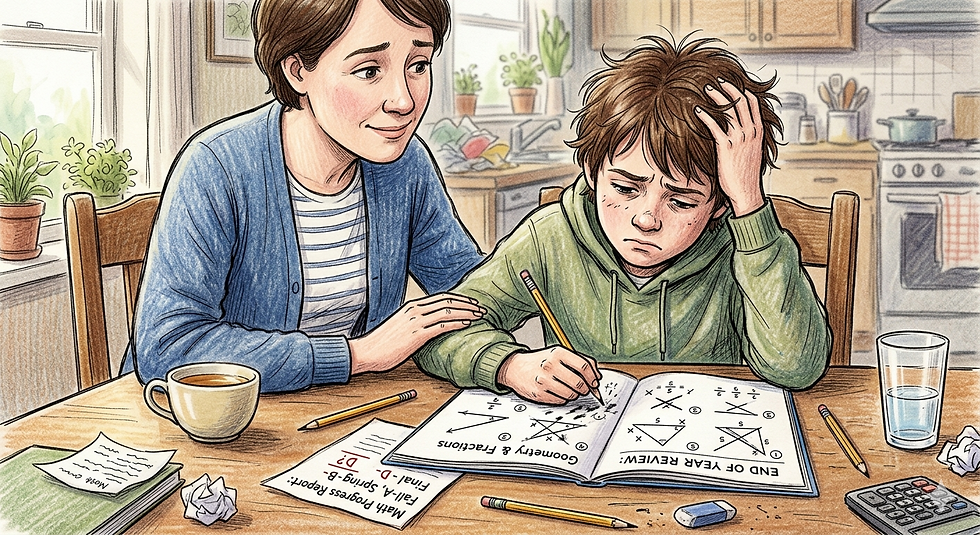
How to Help When Homework Ends in Tears, Shutdowns, and Overwhelm
Every spring, I hear some version of the same question from parents:
“My child used to be fine with math…why are they suddenly melting down?”
Maybe homework now ends in tears.
Maybe your child stares at the page and says nothing.
Maybe they say:
“I’m stupid.” “I hate math.” “I can’t do this.” “Can you just tell me the answer?”
And as a parent, it feels heartbreaking.
Especially when you know they are capable.
The truth is this:
Most math shutdowns are not about laziness. They are about overwhelm.
By the end of the school year, students are carrying months of academic pressure, unfinished learning gaps, testing stress, and emotional fatigue.
For students with ADHD, autism, and other learning differences, that weight can feel even heavier.
As the founder of A to Z Learning, I work with upper elementary and middle school students across the United States from my home base in Utah. Many of the families I support come to me during this season when math has become the nightly battleground.
And the good news is this:
There are ways to help.
Why Is My Child So Stressed About Math Right Now?
What is math anxiety?
Math anxiety is the feeling of stress, fear, or panic connected to math.
It does not always look dramatic.
Sometimes it looks like:
avoiding homework
procrastinating
emotional shutdown
perfectionism
needing constant reassurance
refusing to try
saying “I’m just bad at math”
freezing during tests
getting upset over small mistakes

Research shows math anxiety can significantly affect both academic performance and emotional well-being, and it often creates a difficult cycle:
anxiety lowers performance → lower performance increases anxiety
This cycle often becomes more obvious near the end of the school year.
Why Does It Get Worse at the End of the School Year?
Spring math burnout is real
By May, students are often dealing with:
academic fatigue
state testing pressure
unfinished concepts catching up
harder multi-step assignments
increased expectations for independence
fear of falling behind before next year
For upper elementary and middle school students, math often becomes more abstract during this time.
Fractions, multi-step word problems, pre-algebra thinking, and greater executive functioning demands can make students feel like math suddenly became “too hard.”
For ADHD learners, this often looks like:
task paralysis
missing assignments stacking up
difficulty starting
frustration tolerance dropping fast
For autistic learners, it may look like:
shutdown from cognitive overload
increased rigidity around mistakes
anxiety around transitions and unpredictability
masking fatigue after a long school year
Parents often think:
“They just need to push through.”
But usually, the child’s nervous system is already overloaded.
What Happens When My Child “Shuts Down” During Homework?
It is often a stress response, not defiance
One of the things parents tell me is:
“They understand it when we talk casually, but the second it becomes homework, they freeze.”
This happens because stress changes how the brain works.
When homework feels emotionally loaded, students can move into a threat response; fight, flight, or freeze.
That might look like:
blank staring
refusal to answer
tears
anger
avoidance
asking for constant help
giving up immediately

The problem is not always the math itself.
The problem is the emotional load attached to the math.
More pressure usually makes this worse.
Calm support helps far more.
Can Parents Accidentally Increase Math Anxiety?
Yes, and most parents do it with good intentions
This is one of the most important things to understand.
Research from the University of Chicago found that children of math-anxious parents learned less math over the school year and developed more math anxiety but only when those parents frequently helped with math homework
The problem was not helping.
It was the emotional tone during help.
Things like:
urgency
frustration
overcorrecting
pressure to “just get it done”
anxiety about grades
can unintentionally make math feel unsafe.
This is why I tell parents:
You do not need to become the math teacher.
Sometimes your most powerful job is simply being the calm, safe person in the room.
How Can I Support My Child Right Now?

Focus on emotional safety first
Before confidence comes correctness.
Try these strategies:
Break homework into smaller pieces
Instead of:
“Finish your math homework”
try:
“Let’s do just the first two problems.”
Smaller steps reduce overwhelm.
Normalize mistakes
Say:
“This is hard because you’re learning.”
instead of:
“You know this.”
Pressure often increases shutdown.
Safety helps students keep trying.
Reduce time pressure
Many students with math anxiety panic when they feel rushed.
Slow down.
Let thinking happen.
Speed is not the goal.
Understanding is.
Let them talk through their thinking
Talking out loud helps many students organize their thoughts especially ADHD learners.
Even if the answer is wrong, the thinking matters.
This builds confidence and helps you see where the real gap is.
Use tools without shame
Multiplication charts, scratch paper, visual models, number lines, step-by-step supports
These are not “cheating.”
They are scaffolding.
Strong learners use tools.
A Student I’ll Never Forget
I once worked with a student, we’ll call him Sam, who was drowning in missing assignments.
Math assignments were late.
Homework battles were constant.
He was ready to stop trying.
As we worked together, I realized the problem was not just the current homework.
He was struggling with multiplication facts, but also addition and subtraction fluency.
Every assignment took enormous mental effort.
He was exhausted before he even started.
So we changed the goal.
Not perfection.
Progress.
I encouraged him to use a multiplication table instead of forcing instant recall.
We played games to build faster addition and subtraction fluency.
I encouraged him to talk out loud while solving problems so math felt less overwhelming.
That year, he did not finish every missing assignment.
But something more important happened:
He started believing he could do math again.
By summer, we kept building those foundational skills, and he started the next school year stronger, calmer, and far more confident.
That is the real work.
Not just finishing homework.
Rebuilding trust in themselves.
Is There Anything I Can Do in the Last Few Weeks of School?
Yes! Absolutely
Do not focus on “catching up on everything.”
Focus on:
reducing panic
protecting confidence
strengthening core skills
finishing the year with less fear
Even small wins matter.
Sometimes the best end-of-year goal is not higher grades.
It is helping your child stop believing they are “bad at math.”
That changes everything.
When It Might Be Time for Tutoring
If homework has become a nightly emotional battle, outside support can help.
Especially when:
missing assignments keep growing
your child refuses math completely
your relationship is becoming centered around homework conflict
your child needs confidence, not just answers
executive functioning challenges are making independent work difficult
Sometimes children respond better when help comes from someone outside the parent-child dynamic.
Not because you are doing it wrong.
Because emotional safety matters.
Ready for Support?
If your child is shutting down over math, you do not have to figure it out alone.
Sometimes the right support changes everything.
At A to Z Learning, I help upper elementary and middle school students—including ADHD and autistic learners—rebuild confidence, strengthen foundational math skills, and make math feel manageable again.
I focus on understanding each child as an individual, building trust first, and helping students find a learning method that works for them.
Schedule a Free Consultation
Email Alia at alia@atozlearningutah.com
Let’s talk about how your child can finish the school year stronger.
About the Author
About Alia
Alia is the founder of A to Z Learning, an online tutoring practice based in Utah serving students across the United States.
She holds a B.A. in Elementary Education and Special Education and has spent more than six years working in classrooms supporting students with learning differences, including students with ADHD and autism.
As both an educator and the mother of three neurodivergent children, Alia brings both professional expertise and personal understanding to her work.
Her tutoring focuses on helping upper elementary and middle school students rebuild confidence, strengthen foundational skills, and feel successful in math again.
She believes students learn best when they feel understood, supported, and safe enough to try.
To connect with Alia, email alia@atozlearningutah.com


This was such a thoughtful and encouraging article. I really appreciate how you explained that math stress is often connected to overwhelm, gaps in understanding, pressure, and confidence, not a lack of intelligence. So many children quietly carry the belief that they are “bad at math” when what they truly need is patient support, clear instruction, and time to build a stronger foundation.
You also did such a wonderful job breaking these ideas down in a way parents can actually understand and recognize in their own children. That kind of clarity is so valuable for families who may feel worried, discouraged, or unsure of how to help.
Thank you for taking the time to share your expertise and encouragement so…
Math anxiety is real. So many kids feel like they are not good enough when they cannot figure out the math problems, and sometimes they just need to breathe and take a look at what they do know.
As you said, sometimes the words we use can make students feel a little bit more anxious, and we may not even realize we are doing it. Even a parent helping their child can lead to the same thing. We respond differently to our parents than we do to an outside source. I always share with the families I work with that you might know everything about helping your child with math, and you can be doing everything right. Sometimes, in order…
These are great tips. Many of them are true about reading.