Why Math Matters (Even When It feels Pointless)
- aliazundel
- Feb 2
- 3 min read

Math is one of those subjects that people tend to have strong feelings about. Some love it, some hate it, and then there are those somewhere in the middle. I was an "in-the-middle" student.
Math wasn't easy for me, especially once I reached pre-algebra and letters suddenly showed up next to my numbers. I remember wondering why that even happened and never feeling like I got a clear explanation. Over the years, I've hard many students, especially those who don't enjoy math, ask, "When am I ever going to use this!?!" Honestly, I get it. I might have been one of those voices myself while trying to figure out why I was adding letters instead of numbers.
Math Shows Up More Than We Realize
Even when it doesn't feel obvious, math is used every day in one way or another. We use math when we count, cook, budget, or decide whether we can afford something at the store. We use it to figure out how much money someone selling watermelons will make if each one costs five dollars - or, on the flip side, how much each watermelon needs to cost just to break even.
Some people may never use high school algebra again or calculate the volume of a sphere, and that's okay. The real value of math isn't always int he specific problems - It's in the skills students build while learning hot to solve them.
Math Is About Learning How to Think
Math helps develop important life skills such as reasoning, recognizing patterns, and following step-by-step processes to solve problems. One way it does this is by teaching students how to approach problems in a logical order.
In school, students learn the order of operations, often remember as PEMDAS (Parentheses, Exponents, Multiplication, Division, Addition, Subtraction). I learned it as "Please Excuse My Dear Aunt Sally." While most of us don't use PEMDAS daily, learning it trains our brains to think in terms of first, next, and last - an approach that transfers directly to real-life problem-solving.
The Power of Recognizing Patterns
Math also teaches students how to recognize patterns. Understanding patterns is helpful not just for mathematicians, but for scientists, cooks, hairstylits, authors, parents and many others.
Recognizing patterns helps us understand what has happened, what is happening, and how current actions may affect future outcomes. Patterns in behavior can help us navigate situations at home or work. Weather patterns help us decide how to dress. Traffic patterns help us choose the best time to leave for work and reduce stress in the morning.
Breaking Big Problems Into Manageable Steps
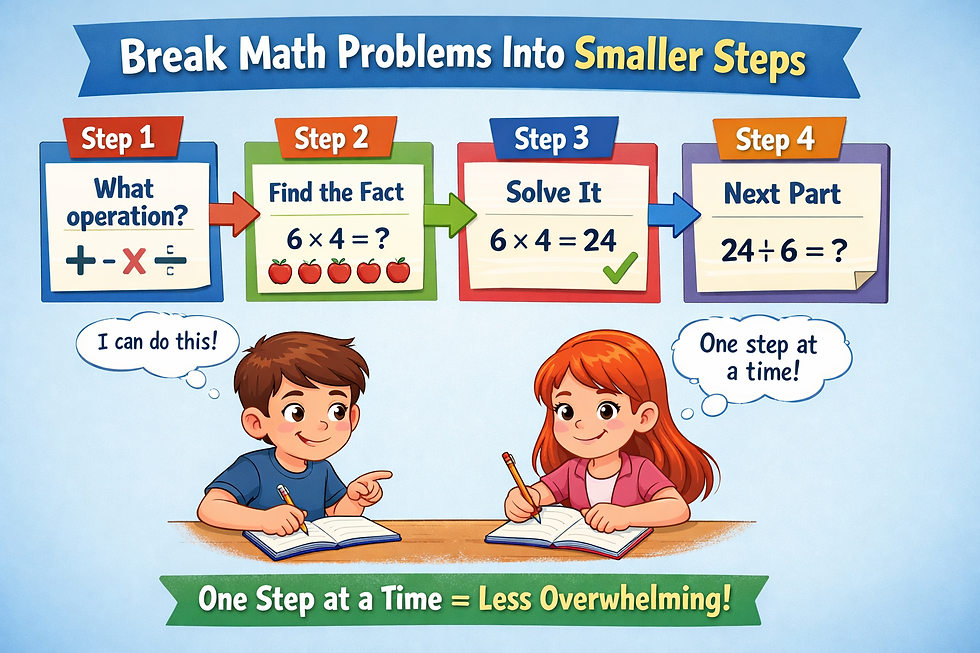
As students move through school, math problems become more complex. Students are taught how to break large, difficult problems into smaller, manageable steps using formulas, equations, and foundational skills.
This is a critical real-life skill. Take gardening, for example. If I wanted to start a garde, I couldn't do everything at once - and I definitely couldn't just will it into existence. I'd need a plan. First, I'd remove the grass. Then I'd prepare the soil, then plant. If I did those steps out of order, the garden wouldn't work. Just like in math, breaking a big idea into smaller, logical steps makes it achieable instead of overwhelming.
Why Practicing Math Still Matters
Practicing math isn't always fun, and it's often hard for students to see how it connects to "real life." But through practice, students develop skills that go far beyond working with numbers. They learn how to think logically, recognize patterns, reason through challenges, and approach problems in an organized way.
These skills may not always be obvious, but they are incredibly important long after the math homework is done.
Your Child Doesn't Have to Struggle Alone
Math doesn't have to be something your child dreads. With patience, practice and the right strategies, students can learn how to break down problems, think logically, and feel more confident in their abilities.
If your child is struggling with math or feeling frustrated and discouraged, extra support can make a meaningful difference. I offer personalized tutoring and would love to talk with you about your child's needs. Contact me today to schedule a free consultation and learn how we can make math feel less overwhelming and more achievable.


Comments