Why Do Smart Students with ADHD or Autism Often Struggle in Math
Why Do Smart Kids Struggle With Math But Not Reading?
Many parents are confused when their child:
reads above grade level
understands complex ideas
does well in most subjects
…but suddenly struggles in math.
This is especially common for students with ADHD or autism in upper elementary and middle school.
The reason often has nothing to do with intelligence.
Instead, the problem is usually missing foundational math skills that compound over time.
Unlike reading, math is extremely sequential. Each new concept builds directly on previous skills.
If a student missed something earlier—like multiplication facts—the gap becomes more noticeable as math gets harder.
Why Math Problems Often Appear in Upper Elementary or Middle School
Many students appear to do fine in early elementary school.
Then suddenly around 4th–6th grade, math becomes much harder.
This is because students begin learning:
fractions
long division
ratios and proportions
multi-step word problems
These topics rely heavily on multiplication fluency.
If multiplication facts are not automatic, students must use extra mental effort just to calculate basic numbers. That leaves very little mental energy for solving the actual problem.
The Hidden Problem: Missing Multiplication Facts
In my tutoring work, one of the most common issues I see is missing multiplication fluency.
A student may understand the math concept perfectly but still struggle because basic facts take too long to recall.
For example, I worked with a student who had a hard time remembering multiplication facts.
We practiced skip-counting songs together. Over time, he began using the songs to help him recall answers.
Sometimes he still gets stuck, but then he pauses, remembers the song, and figures out the multiplication fact he needs.
Once he finds that step, he is able to continue solving the rest of the problem.
This shows something important:
The student understood the math. The missing piece was the multiplication fact.
Why ADHD and Autistic Students Often Experience Math Shutdown
Many students with ADHD experience strong frustration when math becomes overwhelming.
Common reactions include:
shutting down during homework
wanting to stop working
avoiding math altogether
feeling like they are “bad at math”
This shutdown often happens when problems feel too large or complicated all at once.
Students may not know where to start, which triggers stress and avoidance.
A Strategy That Helps: Breaking Math Into Smaller Steps
One strategy that helps many students with ADHD or autism is breaking math problems into smaller parts.
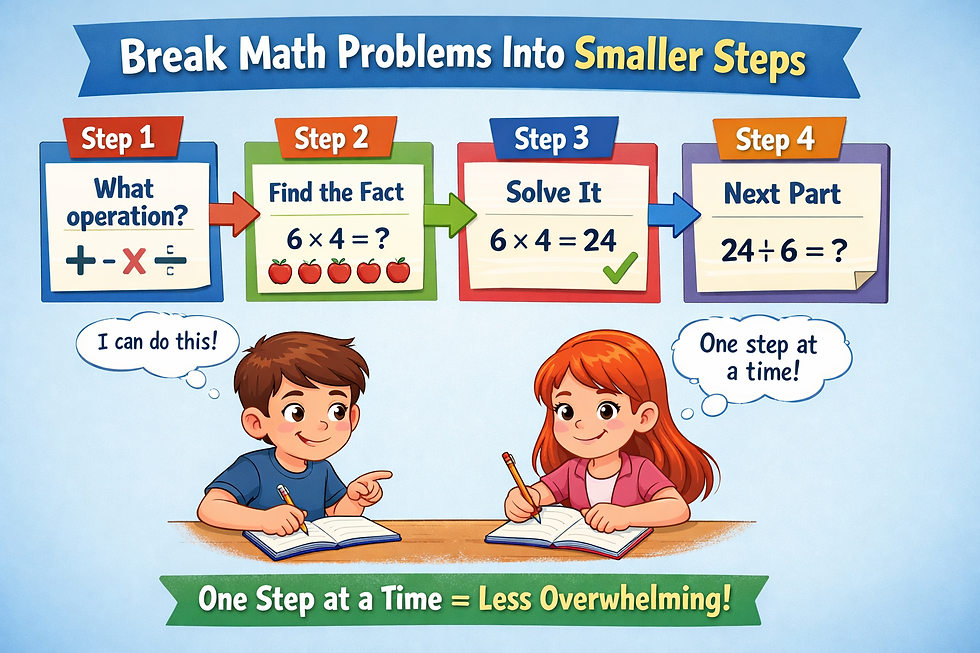
Instead of looking at the entire problem, we focus on one step at a time.
For example:
Identify the operation needed.
Find the multiplication fact required.
Solve that small step.
Move to the next part of the problem.
This reduces overwhelm and helps students build confidence.
Once the student realizes they can solve each small step, the entire problem becomes manageable.
Signs Your Child May Have Foundational Math Gaps
Parents may notice signs like:
strong reading skills but struggling in math
counting on fingers for multiplication
taking a long time to complete homework
frustration or shutdown during math
understanding explanations but struggling with calculations
If these signs appear, the issue may simply be missing foundational math skills, not a lack of intelligence.
The Good News: These Math Gaps Can Be Fixed
The encouraging news is that foundational math gaps are very fixable.
When students:
rebuild multiplication fluency
practice key foundational skills
learn how to break problems into manageable steps
many begin to regain confidence quickly.
Students who once believed they were "bad at math" often discover they are actually very capable once the gaps are filled.
Free Consultation for Parents
If parents feel they need help identifying which math skills their child may be missing, they are welcome to contact Alia Zundel for a free consultation.
During the consultation, parents can discuss their child's challenges in math and learn more about how targeted support can help rebuild foundational skills and confidence.
About the Author
Alia Zundel is a math tutor who specializes in helping students in grades 4 through 8 rebuild confidence in math. She works with many students who have ADHD or autism and feel overwhelmed by math.
Alia holds a teaching license in both General Education and Special Education and spent six years teaching in the classroom before focusing on individualized tutoring.
Through her work with students who are bright but struggling in math, she has seen firsthand how missing foundational skills—especially multiplication fluency—can make later topics like fractions, division, and algebra feel overwhelming.
Her tutoring approach focuses on:
rebuilding foundational math skills
breaking complex problems into manageable steps
supporting neurodivergent learners
helping students move from math frustration to math confidence
She is passionate about helping students discover that they are capable of understanding math when it is taught in a way that works with how their brains learn.


Comments