Why Does My Child Struggle With Math? My Journey From "I'm Not a Math Person" to Teaching Math

If your child has ever said, "I'm just not a math person," you're not alone.
As a math tutor, I hear this often. What surprises many parents is that I used to say the same thing about myself.
For years, I believed I wasn't good at math. I struggled to keep up with classmates, needed more time to process information, and often felt like everyone else understood something I didn't.
Today, I teach and tutor math students in grades 4-8.
What changed?
It wasn't intelligence. It wasn't a hidden talent. It was learning that there is more than one way to understand mathematics.
If you're wondering why your child struggles with math, what causes math anxiety, or whether children who struggle can still become successful mathematicians, I hope my story offers encouragement and practical guidance.
My Story: The Little Girl Who Thought She Wasn't Good at Math

Once upon a time, there was a little girl who loved school.
She loved learning new things and spending time with her friends. School felt exciting and full of possibilities.
Then somewhere around third or fourth grade, things started to change.
While her classmates seemed to finish assignments quickly, this little girl needed more time. She could usually figure out the math, but processing the information took longer.
What seemed straight forward for other students often required extra effort and extra thinking.
As the years passed, math became more complicated.
Each year introduced new concepts that felt harder than the last. By high school, math seemed almost impossible.
This little girl grew into a teenager who sat in class watching her friends grasp new concepts quickly and complete assignments with confidence. She began to wonder what everyone else knew that she didn't.
What was the secret?
What was the magic wand that everyone else seemed to have?
No matter how hard she tried, she couldn't find it.
After graduating from high school, thanks in large part to some incredibly patient teachers, she made a decision:
Math just wasn't for her.
And because she was finished with school, she figured she would never have to worry about math again.
Why Do Some Children Struggle With Math?
Children struggle with math for many different reasons, and those reasons are often misunderstood.
According to the Utah Parent Center, difficulties can stem from a variety of different reasons.
Some of these reasons may be understanding vocabulary, memorization challenges, difficulty with multi-step problems, math anxiety and specific learning disabilities related to mathematics.

Many parents assume a child who struggles with math simply isn't trying hard enough.
Research and educational experts consistently show otherwise.
According to Understood.org, children who struggle with math are often working extremely hard but may need instruction presented differently.
The Myth of the "Math Person"

I spent years thinking that other people were naturally gifted in math while I was not.
I fought to understand explanations that seemed obvious to everyone else.
Math often felt like a foreign language that everyone else seemed to know intuitively.
I was embarrassed that certain skills never became automatic for me. Even multiplication facts required effort long after they seemed effortless for my peers.
When I became a parent, my children would often wait for their dad to come home before asking math questions.
"He does math better than you," they would say.
And honestly, I agreed with them.
That was fine. I helped with reading. He helped with math.
At least, that's what I believed.
Research on growth mindset suggests mathematical ability is not fixed.
In a study examining growth mindset strategies in middle school mathematics classrooms, students demonstrated improvements in both mathematical achievement and attitudes toward learning mathematics (Zeeshan, 2024).
Similarly, education researcher Jo Boaler argues that mathematical success develops through learning experiences, persistence, and effective instruction rather than innate talent (Parker, 2015).
For years, I didn't understand this. I assumed my struggles meant I simply wasn't good at math.
The Class That Changed Everything
Years later, I decided to return to school and become a teacher.
There was a problem though.
Math was required.

Of course it was.
How could I teach elementary students if I couldn't do the math myself?
One particular math class brought back every insecurity I thought I had left behind.
I felt like I was back in high school.
The concepts seemed overwhelming. I questioned whether I was smart enough to pass
the course and continue toward my goal of becoming a teacher.
I was convinced I would fail.
But something unexpected happened.
What Changed?
I wasn't suddenly smarter.
I didn't discover a hidden talent for math.
What changed was the way I learned.
For the first time, I had instructors who broke concepts into smaller pieces.
Instead of simply showing how to solve a problem, they explained each step and why it mattered.
If I became confused, I could stop and focus on that specific step and strive to understand it before moving forward.
I also had access to online resources that explained concepts from multiple perspectives. Thank you Khan Academy and Youtube.
When one explanation didn't make sense, another often did.
Gradually, I began to see connections between concepts that had always seemed unrelated to me.
Ideas that once felt impossible started to make sense.
Yes, the class was still difficult and I still had to work hard.
But what once felt impossible became manageable.
Sometimes it even became enjoyable.
What I Learned About Math Learning
Looking back, I realize that my struggle was never about intelligence.
It was about finding an approach that matched how my brain learned.
Once I was given permission to slow down, ask questions, revisit concepts, and learn through multiple methods, math became accessible in a way it never had before.
That realization changed how I see every student who sits across from me today.
Students develop mathematical thinking through practice, effective instruction, meaningful experiences, and support.
In Clifton Parker’s article, he quotes a mindset researcher, Jo Boaler.
His article emphasises that all students are different in their math thinking.
Some children learn quickly through traditional instruction. This means that they are able to memorize rules and facts. They are also able to calculate quickly.
Society often values this type of learner.
But there are others who need concepts presented visually, creatively, and may need to be given more time to think and understand.
Some need hands-on experiences.
Others need additional processing time, repetition, or opportunities to connect new ideas to concepts they already understand.
Different does not mean less capable.
There is a perception among young learners that being successful means that you don’t struggle and that getting the right answer should feel effortless.
Many students I work with believe that success means getting the right answer quickly and effortlessly.
When they make mistakes, they assume something is wrong with them.
I see it differently.
Struggle is often a sign that learning is happening. Mistakes give us valuable information about what a student understands and where additional support is needed.
They are not evidence of failure. They are part of the learning process.

Through mistakes we can work together to understand what my students are not understanding and help them become a better mathematician.
Some students learn best through visual models and hands-on activities.
Others need opportunities to talk through their reasoning, practice concepts repeatedly, or connect math to real-world situations.
Many simply benefit from additional processing time.
None of these approaches are better or worse than another. They are simply different pathways to understanding.
Different learning styles do not indicate different levels of intelligence.
They simply reflect different pathways to understanding.
Can Children Who Struggle With Math Be Successful?
Yes.
They absolutely become successful mathematicians, engineers, teachers, scientists, business owners, and problem-solvers.
Many successful adults once believed they were "bad at math."
The key is identifying the source of the struggle and providing appropriate support.
Remember, I struggled with math too.
There are many examples of people struggled learning math as children, but eventually learned how to do it and even became successful as adults.
Michael Faraday (“father of electricity”), Charles Darwin (biologist), Alexander Graham Bell (inventor of the first telephone), and Thomas Edison (inventor) among others. (Mark Mancini, 2023)
Learning struggles do not reflect on how smart a child is. (Understood.org)
The key is identifying where the struggle is coming from and providing the support your child needs to build both skills and confidence.
I spent years believing I was not a "math person." Today, I teach math, tutor students, and help children build confidence in skills that once felt impossible to me.

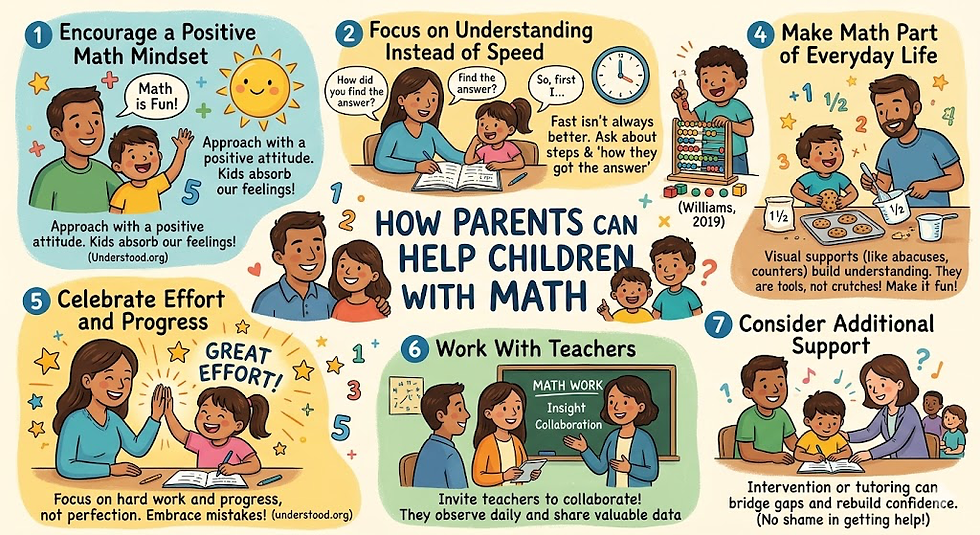
How Parents Can Help Their Children With Math
Many parents come to me worried that their child is falling behind, losing confidence, or beginning to believe they simply are not good at math.
The good news is that difficulties with math are often identifiable and addressable once we understand what is causing them.
So what can you do as a parent?
Encourage a Positive Math Mindset
Approach math with a positive attitude. It doesn’t have to be your most favorite thing in the world to do, but children pick up on our feelings, anxiety, and even joy.
“If we’re negative about math, our kids are going to be negative about math.” "Children often absorb adult attitudes toward math.” (Understood.org)
Focus on Understanding Instead of Speed
Fast does not always mean better.
Make sure your children understand.
Sometimes we assume our children know what we know.
If you are helping with homework, make sure they know what is expected.
You can ask questions about the assignment and see if they can tell you in their own words what the steps are, or how they got the answer they got.
If there are gaps in knowledge, you can help your child identify what the gap is and how they can fix it.
Use Tools and Manipulatives
Visual supports help many learners build understanding.
Let your children use tools to help them solve problems.
An abacus or anything that will help them count, add, subtract, etc. Is helpful for some children who are visual learners.
If you are worried about manipulatives becoming a “crutch” remember they are tools.
When children become confident in their abilities, they will eventually stop using the manipulatives on their own. (Williams, 2019 Northwest).
Make Math Part of Everyday Life
Cooking, shopping, measuring, and games all provide opportunities to practice.
Naturally including your children into daily activities is a great way to connect the need for math with concrete examples used in daily life in a much more meaningful way than a bunch of problems on a page.
Practice using games (power homeschool).
Let’s be honest. Almost everything is better when it’s fun.
Games encourage engagement, which means there is more attention toward the material, which more is being learned. Children are more likely to practice more when they are having fun.
Celebrate Effort and Progress
Growth occurs through practice, mistakes, and persistence.
Focus on effort and progress instead of perfection. (understood.org).
This helps to promote a growth mindset and minimizes perfectionism which helps children feel empowered to try and learn from mistakes.
Bonus: focusing on progress rather than perfection, students often feel more empowered to try new things in the future.
Work With Teachers
Teachers can provide valuable insight into where struggles begin.
I would encourage you to invite your child’s teacher or teachers into the conversation.
Teachers are trained professionals who have your child’s educational success in mind.
They work with your children on an almost daily basis and they could have some insight into your child’s struggles.
At the least, they can share their observations and data in the form of tests and classwork to help get an insight.
Consider Additional Support
Sometimes targeted intervention or tutoring can help bridge gaps and rebuild confidence.
If, with support from you and your child’s teacher, your kiddo is still struggling, it may be time to bring in additional help.
There is no shame in getting help from an interventionist or a tutor. In fact it is giving your child every chance to become a successful student and later a successful and confident adult.
Why I Chose to Work With Struggling Math Students
Adult me feels more confident when I work with math now for myself and as I help my students.
I will admit that sometimes I still freeze up a little when I see something unfamiliar. I don’t let it stop me though.
I know that math is like a puzzle.
It is a big picture made up of several smaller pieces.
Once I can identify those smaller pieces, what they look like, and how they fit in the bigger picture, I can make each piece work with the other to get the answer.
I am more patient with myself when I make mistakes. I know that mistakes do not define me.
A secret between you and me, sometimes I still make mistakes and my kids I work with love to point out that they caught Ms. Alia’s mistake.
On the surface it is a boost to their confidence that they knew something that maybe the adult they work with didn’t.
On a deeper level, I believe they see my example. They see me make mistakes, yes I admit when I get it wrong, and we discuss together what happened and how to fix it.
The most rewarding part is that my kids know it is ok to make mistakes.
Making mistakes, identifying mistakes, and figuring out what went wrong and how to fix them is how we learn and become stronger.
Today, when I work with students who struggle in math, I see pieces of my younger self.
I see the child who thinks everyone else understands something they don't.
I see the student who believes they're behind.
I see the frustration, anxiety, and self-doubt that can develop when learning feels harder than it should.
Most importantly, I know those feelings do not determine a child's potential.
My own experience taught me that there is rarely just one way to learn a concept.
When one teaching approach doesn't work, that doesn't mean the child can't learn.
It means we need a different approach and that’s ok.
As we figure out different approaches, it increases creativity, and opens our minds to different possibilities. We also improve the logic centers of our brains, potentially improving our flexibility and growth mindset toward other topics.
Sometimes the breakthrough comes from slowing down and breaking the puzzle into smaller problems.
Sometimes it comes from making connections to prior knowledge.
Sometimes it comes from presenting the same concept in a completely different way.
Regardless of how it is done, I want my students to know every mistake is simply information that helps us find the next step forward.
It is harder sometimes, but I know that with the right support this is how children become stronger.
What I Want Parents to Remember
If there is one thing I hope you take away from my story, it is this:
Struggling with math or any other subjects does not mean your child lacks intelligence, ability, or potential.
I spent years believing I wasn't a math person.
Today, I teach math, tutor students, and help students build confidence in skills that once felt impossible for me.
The difference was not intelligence.
The difference was support, instruction, and finding an approach that matched the way I learned.
I believe the same is possible for your child.
About the Author
Alia Zundel is the founder of A to Z Learning LLC, an online math tutoring practice dedicated to helping students in grades 4-8 build confidence and success in mathematics. As a licensed educator with certifications in General Education (K-8) and Special Education (K-12), Alia specializes in supporting students who learn differently, including those with ADHD, autism, anxiety, processing differences, and math confidence challenges.
What makes Alia's approach unique is that her passion for helping struggling learners comes from personal experience. As a child, she often felt overwhelmed by math and spent years believing she simply wasn't a "math person." Today, she uses that experience to help students discover that success in math isn't about being naturally gifted—it's about finding the right approach, building strong foundations, and developing confidence through supportive instruction.
In addition to being an educator, Alia is the mother of three neurodivergent children. She understands firsthand the challenges families face when a child struggles in school and believes every child deserves to feel capable, supported, and successful.
Through personalized instruction, patience, and evidence-based teaching strategies, Alia helps students strengthen their math skills while developing the confidence to tackle challenges both inside and outside the classroom.
To learn more about A to Z Learning or schedule a consultation, visit AtoZLearningUtah.com.
FAQ
Why is my child suddenly struggling with math?
Math concepts build on previous skills. Missing foundational understanding can make new concepts feel overwhelming. For more information check out this blog.
Can math anxiety make it harder to learn math?
Yes. Anxiety can interfere with working memory, attention, and problem-solving, making math feel more difficult than it actually is.
Is struggling with math a sign of low intelligence?
No. Many highly intelligent children struggle with mathematics due to learning differences, processing speed, working memory challenges, or instructional mismatches.
Can children with ADHD succeed in math?
Absolutely. Many students with ADHD thrive when instruction includes movement, visual supports, structured practice, and accommodations that fit their learning needs.
Does needing extra time mean my child is behind?
Not necessarily. Some learners simply process information differently and benefit from additional time to develop deep understanding.
When should I hire a math tutor?
Consider tutoring when your child consistently experiences frustration, falling grades, loss of confidence, or ongoing difficulty despite classroom and home support.
References
Parker, C. B. (2015, December 17). Cultivating a growth mindset in mathematics. Stanford Graduate School of Education. Retrieved from https://ed.stanford.edu/news/cultivating-growth-mindset-math
Zeeshan, I. (2024). Examining the Effects of Growth Mindset Strategies on Middle School Students' Performance in Mathematics in Georgia, USA. European Journal of Education Studies. Retrieved from https://eu-opensci.org/index.php/ejedu/article/view/30990
Understood.org. (n.d.). Understanding your child's trouble with math. Retrieved from https://www.understood.org/en/articles/understanding-your-childs-trouble-with-math
Understood.org. (n.d.). What is math anxiety? Retrieved from https://www.understood.org/en/articles/what-is-math-anxiety
Utah Parent Center. (2018). Struggling Students in Math. Retrieved from https://utahparentcenter.org/wp-content/uploads/2018/03/Struggling-Sudents-in-Math.pdf
Education Northwest. (n.d.). Teaching math to struggling learners. Retrieved from https://educationnorthwest.org/insights/teaching-math-struggling-learners
Power Homeschool. (n.d.). Helping students who are struggling with math. Retrieved from https://www.powerhomeschool.org/articles/helping-students-who-are-struggling-with-math/
Mark Manchini. (2023). 6 Famous Scientists and Inventors Who Struggled With Math. Mental Floss. Retrieved from https://www.mentalfloss.com/article/69251/6-famous-scientists-and-inventors-who-struggled-math



Comments